
New federal loan limits took effect in July 2026. If you were counting on Parent PLUS to cover the college costs left after aid, savings, and income, you may be able to borrow less than you expected.
The One Big Beautiful Bill Act became law on July 4, 2025. Many of its college-loan changes took effect July 1, 2026, for the 2026-27 academic year. Current federal materials also call the law the Working Families Tax Cuts Act. Federal Student Aid's final-regulations notice documents the law and implementation.
The Parent PLUS cap affects the budgets parents of high school students are making now. Families already paying college bills should check whether they qualify for a temporary exception. Different limits apply to graduate students.
Parent PLUS now has annual and total limits
For families who do not qualify for the interim exception, Parent PLUS borrowing is limited to $20,000 per academic year and $65,000 in total per dependent student. Both limits apply across all parents borrowing for that child. Two parents cannot each borrow $20,000 for the same student in the same year. Federal Student Aid explains the combined limits.
Borrowing is also limited by the school's cost of attendance minus other aid, and the school may impose a lower program limit. Repaying a Parent PLUS loan does not restore room under the new total cap. See the current Parent PLUS rules.
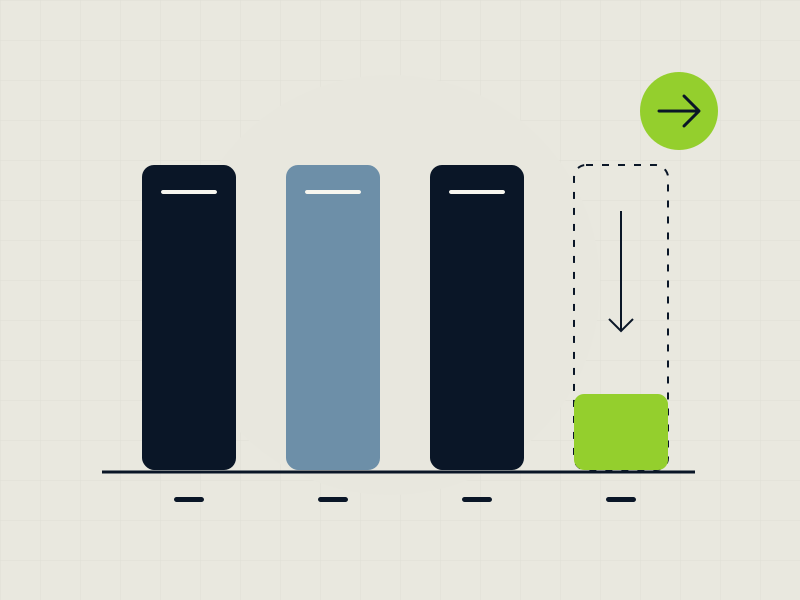
The total limit creates a problem that an annual budget can miss. Consider this hypothetical borrowing schedule for one child, assuming the family is subject to the new limits and otherwise qualifies:
| Academic year | Parent PLUS borrowed | Total borrowed for the child |
|---|---|---|
| First year | $20,000 | $20,000 |
| Second year | $20,000 | $40,000 |
| Third year | $20,000 | $60,000 |
| Fourth year | $5,000 remaining under the cap | $65,000 |
A family needing $20,000 in the fourth year would have a $15,000 shortfall in this example. Spreading $65,000 evenly across four years would average $16,250 a year.
Hypothetical Parent PLUS borrowing for one child, outside the interim exception.
gap*
*If the family still needs $20,000 in year four. Limits are shared across parents. Eligibility and other borrowing limits also apply.
Some current students qualify for a temporary exception
Eligibility generally requires enrollment in the program at the institution on June 30, 2026, and a qualifying Direct Loan disbursed for that program before July 1, 2026. A student's prior Direct Loan can establish eligibility for a parent's exception even if the parent had not previously borrowed Parent PLUS.
The exception lasts for the shorter of three academic years or the remaining program time calculated under the federal rules. It is not a fresh three-year allowance for every continuing student. Changing schools or interrupting enrollment can affect eligibility. Federal Student Aid's loan-limit FAQ explains the exception and its conditions.
Ask the financial aid office to confirm whether your student qualifies and when the exception ends. Get that answer before relying on older borrowing limits, especially if the student is considering a transfer or leave.
Graduate students face different limits
Grad PLUS is no longer available for new borrowing outside the limited exception. The new standard Direct Unsubsidized limits distinguish graduate study from qualifying professional programs:
| Borrower category outside the exception | Annual limit | Aggregate limit |
|---|---|---|
| Graduate student with no prior professional-program borrowing | $20,500 | $100,000 |
| Professional student | $50,000 | $200,000, reduced by applicable prior graduate borrowing |
Students who move between graduate and professional programs have additional coordination rules. These categories do not provide separate pots of money that can simply be added together. Federal Student Aid describes graduate and professional borrowing limits in its loan counseling guidance.
A separate $257,500 lifetime federal student-loan limit also applies outside the exception. It includes undergraduate borrowing and prior Grad PLUS loans; Parent PLUS borrowed for a dependent child is excluded. See the lifetime-limit section of the federal FAQ.
The definition of a qualifying professional program has been affected by litigation. Federal Student Aid issued an interim program list following a court order. Ask the school's aid office which classification and limit apply to the exact degree program. A degree's name alone is not enough to determine the answer. Read the federal court-order guidance.
For a high school student already considering a career that requires graduate school, include that later borrowing need in the undergraduate college discussion. Spending more now can leave fewer financial options for the next degree.
How colleges are responding
Colleges have responded with guidance on the new rules and information about other ways to borrow. These responses vary by school and do not establish a nationwide reduction in tuition.
Boston University says families may need funding beyond the new Parent PLUS limits. Its financial aid update directs students to private-loan information and a comparison tool through Credible. BU gives similar guidance to graduate students facing a funding gap. Read BU's federal financial aid update.
Yale Law's 2026-27 financial aid handbook describes its search for alternatives to Grad PLUS, including a loan through SoFi for eligible students and options from other private lenders. Yale states that students may choose other lenders and that it does not endorse the listed providers. See pages 11-12 of Yale Law's handbook.
Penn has also advertised information sessions about the new graduate-loan rules, borrowing limits, and private-lender options. Its student financial services page lists the sessions.
Ask each college what it can offer your child: additional grant aid, an institutional loan, or a payment arrangement. Request the terms for any option you are considering. A link to a private lender does not reduce the college's price or guarantee approval.
Private loans can have different eligibility rules and protections from federal loans. Compare the repayment terms and any cosigner obligation before treating one as a substitute for unavailable federal funding. The CFPB explains the differences.
Other changes can affect the family plan
The standard undergraduate Direct Loan limits did not increase to fill these gaps. Students enrolled less than full time can also face reduced annual eligibility under the new proration rules. Ask the aid office how a planned course load affects the award before dropping a class. BU explains the enrollment-based reductions.
FAFSA asset reporting changed beginning with 2026-27. The federal calculation excludes qualifying family-owned businesses with 100 or fewer full-time-equivalent employees, farms where the family lives, and qualifying family-owned commercial fishing businesses. Read the form's current instructions before carrying forward an older answer. Federal Student Aid lists these changes.
Repayment options also changed. The new Repayment Assistance Plan, or RAP, is available for eligible student loans, but Parent PLUS loans and consolidation loans that repaid Parent PLUS are excluded. A parent should not assume the child's income-based repayment options will be available for the parent's debt. Federal Student Aid explains repayment eligibility.
Update the budget before committing to the next year
For each college, write down the expected cost after grants, your available savings, and the amount you can contribute from income. Then enter the loans your student and family are eligible to receive for every remaining year.
If the numbers leave a gap, ask the school about aid and financing options while there is still time to compare alternatives. Keep any unapproved loan or hoped-for grant outside the committed-funding total.
Our college funding planning service for Massachusetts families can help organize that discussion. Bring the current aid offer and borrowing history, along with the school's answer about any exception, so the plan reflects the rules that apply to your child.
Sources checked October 15, 2026. Rules and school policies can change. Confirm requirements with the relevant financial aid office.